Category Archives: Uncategorized

Optical Platforms, A Perfect Fit

Central to the deployment of cutting edge technologies that require dynamic sensors and precision photonics, such as self-driving cars, laser communication, and medical equipment, optical stages are at the core of these systems. Optical systems often require precise, highly linear and cogless brushless DC motors to actuate lenses and prisms for directing laser beams, or to collect light need in high speed communications, sensing, or scanning.

An optical platform refers to any instrument that relies on photons to transmit, receive, or direct energy. Common forms of optical platforms include metrology instrumentation, medical diagnostics, inspection equipment, free-space laser communication, as well as LiDAR scanners.

Optical Communications Terminals (OCT), used in both terrestrial and space-based applications are a kind of gimbaling device that transmit and receive data through free space. Mounted on a turret, these devices use highly collimated light generated by lasers to communicate at high rates of speed, over long distances, including in satellite-to-satellite communication. ThinGap’s LS Series of slotless motor kits is an industry leader for gimbal applications requiring high performance and efficiency, as well as decisive move-and-hold positioning, and smooth motion for long-range target lock. LS motors have been widely used in OCT systems and even NASA’s PACE Mission’s optical scanner.

The emergence of self-driving vehicles and other unmanned systems has been enabled by the integration of LiDAR technology. LiDAR is an acronym that stands for Light Detection And Ranging, and operates by projecting out laser energy and then measuring the time it takes for it to be returned. LiDAR platforms benefit from slotless motor technology, such as ThinGap’s TG series that combines extremely precise and controlled movement, high speed, and a large throughhole needed for tight integration.

Broader use of optical systems includes laser guidance and directed energy for the military, scientific spectroscopy, and medical treatment and diagnostics. Industrial segments, like semiconductor wafer processing and test heavily rely on the precision of optical systems, as does material processing. In most cases, to leverage the precision of highly collimated light and highly sensitive sensors, precision actuation is need in the form of smooth motion profiles, highly linear torque constant and little or no hysteresis caused by the motor.

Low profile and high torque air-core motors are a perfect fit for many optical systems. With a large through hole, lenses or prisms can be integrated inside the footprint of the motor. Precision, cogless motion is demanded in both transmission and receipt of photonic signals, and quality, qualification for medical or space and reliability go together with these targeted applications.

ThinGap’s LS and TG Series of motor kits come in sizes from 25 mm up to 267 mm OD, with modified and full custom options are also available. All ThinGap motors are zero cogging and have a thin coil, with a large through-hole. The LS Series are designed for torquer motor applications, and feature a steel lamination stack that retains the stator coil, and ideal thermally efficient architecture for clamping or bonding into systems. The TG Series offers both high speed and high torque performance, and is ideal for haptic feedback because its ironless stator produces no attractive forces when unpowered.

What is Cogging Torque?

As the primary feature and the focus of ThinGap’s product lineup, a lot has been spoken about zero cogging torque in the product lineup. Cogging torque is the interaction between the permanent magnets in the rotor, and the slots of the stator. Because the rotor magnets are attracted to the stator teeth, the torque required to move the rotor changes with the relative position of the rotor to the stator. In other words, additional energy is required to break the position dependent detent torque to advance the motor.

Cogging torque adds harmonic content to the torque-versus-angle curves for each phase. When driven by a sinusoidal current, harmonic content of the torque-versus-angle curves cause undesirable variations in torque production that interfere with smooth motor rotation. Additionally, phase imbalance common in a traditional slotted motor can further exacerbate the issue. The result is a phenomenon known as torque-ripple which is a variation of torque production with position.

There are a few issues when trying to integrate a traditional cogging motor into an application that requires precision actuation. To mitigate cogging torque in a slotted motor, it is possible to design the lamination stack with a rotational skew, so the magnetic field of the stator is diagonal to that of the magnetic field of the rotor. Alternatively, the magnets can be designed with a skew. Other techniques include using different slot-pole combinations and compensating for cogging and phase imbalance in the drive electronics.

However, when integrating slotted motors into systems for precision actuation, there will always be issues. Due to the nature of manufacturing, there is always variance between two seemingly identical motors, which can have an unpredictable impact on the cogging profile and phase balance. Furthermore, solutions to minimize cogging torque typically reduce the total output of the motor. The sunk cost of trying to mitigate cogging torque on both motor costs and development labor is better spent on the correct solution: slotless, coggless, brushless DC motors from ThinGap.


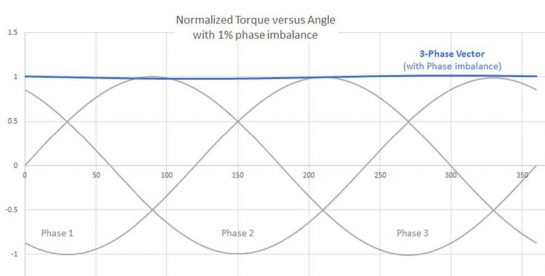
The benefit of ThinGap slotless and ironless motor designs is that they eliminate cogging torque by design. Their uniquely constructed phase windings produce a balanced phase amplitude and angle relationships between phases. This results in less than 1% total harmonic distortion of the back EMF waveform which minimizes torque ripple when paired with sinusoidal drive electronics.

A graph depicting normalized torque-vs-angle curves, with 1% phase imbalance.

ThinGap’s slotless motor architecture with wave-wound coils prevents cogging since the air-core rotor has no slots. Wound around a flat bobbin with a basket weave style winding, ThinGap’s composite air core motor kits have no iron. The thin nature of the coils produces very high copper packing and a motor with a large through hole, up to 80% of the outer diameter. In addition, ThinGap’s motor kits are available with Halbach array rotors, optimizing the magnetic flux for the highest torque density in a slotless motor.

To learn more about zero-cogging motion solutions, please contact us.

ThinGap’s TG Series for Flywheel Applications

For many years, ThinGap motors have been successfully used in a variety of flywheel applications, ranging from gyro-stabilization in boats and satellites, to momentum storage for renewable energy. ThinGap’s TG Series of slotless motor kits are ideal for flywheel applications because of their highly efficient lightweight composite stator, optimal balance between torque and inertia, with negligible rotational losses, and zero cogging that is critical to achieving smooth motion at high speed.

A photo montage detailing an exploded ThinGap TG motor kit, a sailing yacht, and a satellite above the earth, with the caption "Flywheel Momentum Storage"

Boats of all sizes stand to benefit from gyroscopic stabilization. Due to Newton’s third law of motion – every action carrying an equal and opposite reaction, a gyroscopes motion can be used to stabilize a ship or boat in heavy seas. A marine gyro-stabilizer is a large, spinning flywheel housed in the depths of the ship, near the keel. As the flywheel spins, computers on the bridge orient the flywheel against the ships current rolling motion, cancelling it out. ThinGap’s high efficiency motors make an excellent flywheel stabilizer of all sizes and can withstand harsh marine environments.

Another application where gyroscopic flywheels are used to change orientation is with satellites and their use of Reaction Wheel Assemblies. Yet another case of Newton’s Third Law, when a reaction wheel is spun up inside a satellite, the spacecraft turns in the opposite direction of the flywheel’s rotation, with this being used to steer and orient spacecraft in orbit. Because motion in space is multi-axial, each satellite carries multiple reaction wheels in an assembly to freely rotate. Since 2015, ThinGap has shipped thousands of kits for reaction wheel assemblies in large commercial and Government funded constellations, and in 2022, spun off their reaction wheel assembly motor kits to a separate product line.

An emerging use for highly efficient slotless motor kits is in momentum storage. Pioneered more than a decade ago for motorsports applications, excess or available energy is transferred to a motor that spins up a flywheel, whereby storing that energy in a rotating mass as a mechanical battery, instead of as chemical energy. Advantages of retaining the energy in a momentum flywheel application includes high power density compared with conventional batteries for quicker charge and discharge. Future applications of momentum storage could even extend to emerging markets such as renewable energy.

ThinGap’s ironless stator puts all the magnetics, the heaviest part of the motor, in the rotor. This maximizes the inertia for a given weight and size requirement, meaning the necessary flywheel mass can be reduced, and sometimes fully incorporated into the rotor, resulting in a lighter weight package for the same momentum storage capacity. Due to no iron saturation in the stator, ThinGap’s peak torque capacity is much higher for a similar weight motor, giving a dynamic response significantly better than the competition at a lighter weight.

To learn more about ThinGap’s TG Series of motor kits, click here.

Rapid Reaction Design and Manufacturing

A graphic showcasing ThinGap's Camarillo location, next to a photo of a man carrying a box with the LS Series motor superimposed

Quick turn sample quantiles.  Industry leading lead-times.  On demand applications support. Standard, modified and custom options. ThinGap is the market leader in high performance, zero-cogging brushless DC motor kits and prides itself on the ability to rapidly react to both market demands and customer specific requirements.

Since 1999, ThinGap has developed over 100 motor designs, and shipped thousands of motors to a wide range of customers, from NASA to Fortune 500 companies, and even top Formula 1 teams. One of the key enabling factors is attributed to a tight integration of production, engineering, and operations at a single location in Camarillo, California.

ThinGap’s rapid reaction capabilities are reflected in sample quantity products often shipping within one week or less, a ramp to production volumes ship in 3-4 months, and preliminary custom designs and CAD available in 48 hours and custom design builds as soon as 12 weeks. Because of ThinGap’s advanced analytical modelling, final designs are usually within 95% of prediction performance. Well defined production processes, 3D printed tooling, refined modeling and analytical tools all contribute to the ability quickly support customers in a fast paced marketplace.

To learn more about ThinGap’s quick reaction production, click here.

Low Profile, High-Torque Precision Motors for Semiconductor, Packaging and Test Equipment

With demand for electronics at an all-time high and a global supply shortage, the Semiconductor Equipment industry is busier than ever. Today’s modern wafer processing, automatic test and packaging system have a need for increased force density and high resolution move and hold steps. Highly precise, yet compact designs help enable inline process steps that are critical to higher throughput.

A photo of semiconductor equipment with the ThinGap LS motor kit superimposed.

There are many needs for high precision BLDC electric motors in every stage of semiconductor production, from wafer processing all the way to inline testing. Motor selection is critical to system architecture, and factors in control methods, feedback requirements, and mechanical attributes.

Motors and actuators used for these applications are required to deliver cogless and absolute precision. Low profile motor architecture is ideal, because of the large internal aperture so optics or cabling can be routed through the middle. In addition to wafer positioning, precision motors are needed to direct optical systems, such as beam steering, with precision actuation to deliver precision to the micron level.

The continued use of Direct Drive solutions enables system-level advancements needed by semiconductor processing and test equipment.  Rapid and accurate movement defines the performance specifications.

Beyond zero cogging, ThinGap motor kits have near zero Eddy-current, low hysteresis, and a harmonic distortion of less than 1%, so torque output is directly proportional to current throughout the operating range. The resulting smooth motion, linear output, and low profile of ThinGap’s motor kits make them perfect for use in precision applications. Slotless motor kits with high torque, direct-drive capabilities are in many cases the ideal solution for semiconductor equipment.

ThinGap’s LS Series of slotless motor kits is an industry leader for applications requiring performance and efficiency. Standard LS motor kits range in size from 25 to 267 mm diameter and produce torque from 0.1 to 12.0 N-m continuous. With standard and modified configurations, the product line will cover voltages from 24-400 volts and current from 1 to 100 amps.

To learn more about the LS Series, click here.

The Industry’s First Application-Specific Reaction Wheel Motor Line The “TGR” Series of High Efficiency, High Inertia, Ironless-Core Motors

ThinGap has made available two new Space-rated frameless motor kits specifically designed for Reaction Wheel Assemblies (RWA) used to control small and miniaturized satellites. The new TGR 29-12 and TGR 45-20 are an extension of the widely used TG Series of aerospace motors supplied by ThinGap for nearly two decades.  The vacuum compatible parts are 29mm and 45mm wide, and 12mm and 20mm tall, respectively.

ThinGap’s patented motor architecture has inherent advantages in RWA and flywheel applications: an efficient ironless core, zero cogging stator, high torque capacity, dynamic responsiveness, and overall weight savings.

The “air core” architecture lends itself to very low drag at high operating speeds and cogless torque. The wave-wound design of the stator produces a sinusoidal Back-EMF with total harmonic distortion of less than 1%. The precision hand wound coil results in a phase-to-phase balance within 1 degree. In combination, these produce the highest precision RWA motors available which yields essentially pure torque vector control with very low losses and zero cogging.

The new TGR’s design puts all the magnetics (the heaviest part of the motor) in the rotor, maximizing the inertia for a given weight and size. The resulting package is lighter weight for the same momentum storage capacity, and because of no iron saturation in the stator, ThinGap’s peak torque capacity is much higher than a similar weight motor. This gives a high dynamic response significantly better than the competition at a lighter weight. The motors are also highly efficient (up to 95%) since the architecture lends itself to very low drag at high operating speeds.

The TGR 29-12’s offers a continuous torque of 0.012 N-m and 0.0054 N-m/√W motor constant. The TGR 45-20 offers a continuous torque of 0.075 N-m and 0.0197 N-m/√W motor constant. This allows the new TGR motor kits to offer more than double the torque of the closest competitor with minimal losses.

Prior TG Series models have been widely used in RWA systems. Sample quantities of the new TGR 29-12 and TGR 45-20 are available with a 12 week lead time.  Additional models of the TGR Series will include a 79 mm and 61 mm OD part set to be released later in 2022.

To learn more, click here.

Small But Mighty, the LSI 39 Range Offers Breakthrough In Precision Actuation

ThinGap has continued the build-out the LS Series of slotless motor kits with release of the LSI 39 parts offering. The new LSI 39’s, with their small 39 mm (1.5 inch) outer diameter (OD), are targeted for use in robotics, gimbals and precision industrial applications, including semiconductor production and test equipment. Like all LSI products, they can also be modified for vacuum compatibility, as needed in Space-based systems.

The new LSI 39 motors are available in three different axial heights (10 mm, 17 mm, and 39 mm) and are zero cogging, low in profile and have a highly linear torque output. The motors are intended to fit between the existing LSI 25 and LSI 51 motor kits, and can deliver between 0.03 and 0.28 N-m of continuous torque at 6,400 RPM.

Low-rate product quantities of the new LSI 39 products will be shipped to customers in early February. Complete datasheets and CAD model are available at thingap.com for immediate design considerations.

To see the full LS Series of motor kits, click here.

ThinGap Demonstrates Large Motor Capability with the Delivery of its LSO 393

Camarillo, CA (January 11, 2022) – ThinGap has delivered its latest large-size production unit, the LSO 393-31 motor kit to a commercial customer. The LSO 393-31 motor kit has an outer diameter (OD) of 393 mm and an axial height of 31 mm, providing a continuous torque output of 14.47 N-m, and a peak torque of 93.0 N-m.

With 20 years of experience in the design and production of its slotless motor kits, ThinGap is able to leverage proven analytical models and advanced design optimization that results in highly accurate transitions from predicted performance to test results. Furthermore, the process steps needed to produce motors of all sizes is highly scalable. ThinGap has shipped “large” class motors in the nominal sizes of 230-, 280-, 400-, 500-, and 600-mm OD, ranging in output of 10 to 400 kW of output energy.

Customers looking for unique and demanding performance requirements have repeatedly come to ThinGap for custom, application-specific, and modified-standard products to meeting their demanding applications. The recent repeated delivery of the LSO 393-31 is yet another example of this capability.

New LSI 39 Expands LS Line And Offers Deep Integration

ThinGap has continued the build-out the LS Series of slotless motor kits with the latest release, three different LS “in-runner” frameless motor kits. The new LSI 39 products have an outer dimension (OD) of 39 mm or 1.5 inches, and are available in three different axial heights of 10 mm, 17 mm, and 39 mm. These motors are able to deliver between 0.033 and 0.279 N-m of continuous torque at 6,400 RPM. Much higher levels of peak torque are possible for shorter durations. Low rate product quantities of the new LSI 39 products will be shipped to customers in January 2022, and complete datasheets and CAD model are available for immediate design considerations.

Like all ThinGap motors, aside from being cogless, the stator windings are very thin and the rotor is optimized, resulting in a precision movement within a low-profile form factor with a very large through-hole. The LS line of torquer motors is being widely used in gimbals, optics, robotics and precision industrial applications that need cogless movement and are also looking for efficiency, low harmonic distortion, highly linear torque output and a compact form factor.

“The addition of a new smaller-sized set of motor to the LS Series really helps fill out the lower end of the product line,” said Joseph Kay, Director of Engineering at ThinGap. “We continue to establish ourselves as the market leader for slotless motor kits and assemblies, whether as part of our Standard Products or commonly modified-standard, and custom designs.”

This new variant of the LS fits in between the already established LSI 25 and LSI 51 motors sized motor sets and is part of the ongoing addition of variants within ThinGap’s LS product line. The LS Line of is ideally suited for smooth and precise motion in targeted applications in the typical aerospace, medical, precision industrial and communications markets. With OD sizes from as small as 25 mm and up to 267 mm, the LS line range in continuous torque from 0.1 N-m up to 12 N-m.

ThinGap Staff Renews and Expands its Annual IPC J-STD Training

As a leading maker of high-performance motor kits used in a range of applications, ThinGap’s staff recently completed its annual IPC J-STD Training and Certification.


ThinGap is ISO 9001:2015 certified and supports customer-specific flow downs as part of program compliance and its Quality Management System. Industry-leading process and workmanship standards, such as IPC J-STD for soldering, are used throughout the production process. The annual training and certification of the J-STD is a key aspect of ThinGap’s quality control.

IPC is the global association that helps manufacturers and electronics industry suppliers build electronics and electronic components to higher standards. Like in years’ past, ThinGap production staff as well as quality control personnel underwent training to the IPC J-STD-001 specification. J-STD-001, is the Requirements for Soldered Electrical and Electronic Assemblies and the preeminent standard for electronics assembly manufacturing. The standard describes materials, methods, and verification criteria for producing a broad range of high-quality interconnections and emphasizes process control.

Workmanship standards, such as IPC J-STD and others like the American National Standards Institute or “ANSI” standards, are used throughout ThinGap’s production process. Furthermore, all documents and procedures are controlled by the Company’s Product Lifecycle Management (PLM) system.

ThinGap has a track record of supporting the exacting requirements for its base of Fortune 500 companies, Government customers including NASA, and regulatory specifications across multiple sectors, be it Space, Medical, Defense or Airborne.